The circle is a myth. The frame is four by five.
Every article about the therapist directory repeats the same two numbers. We asked the directory instead.
Three sizes, and the smallest one does the choosing
Psychology Today does not store your photograph at one size. Its image host makes renditions on request, and there are exactly three of them. We asked for the sizes everybody recommends, on two different profiles, in August 2026: 400 by 400 answered 404, so did 300 by 300, so did every square and every circle. These three answered with photographs, and all three are 4:5.
- 80 x 100 · in a list
- 120 x 150 · in a card
- 320 x 400 · on the profile
Which changes what the photograph has to do. At 80 pixels wide there is no room for a room: the face either reads at that size or the profile is skipped before anybody has read a word of it. And because the renditions are derived from your upload rather than stored, the resolution you hand over governs all three. A shoot here delivers 1152 by 1440, which is four times the largest rendition on its long edge. Upload that, not something a website has already squeezed.
The props that cost you the client
Every other profession this studio photographs is trying to look more authoritative. A lawyer wants a wall of law books behind them; an executive wants the boardroom. For this one the evidence runs the other way, and it has been measured more than once.
In a 2026 comparison of four therapist presentations across 330 people, the one staged as a recognisable therapist, formal clothing and the profession's own props, scored lowest of the four on being understood and lowest on willingness to seek treatment. A much older study of attire and seating found the highest ratings came from casual dress with no desk in the frame, and that women rated the behind-the-desk arrangement lower on every measure taken.
So the question a visitor is asking your photograph is not whether you are credible. They already assume the licence. The question is whether they could sit in a room with you and say the thing they have not said to anybody, and the visual grammar that answers that is the opposite of the one that answers the first.
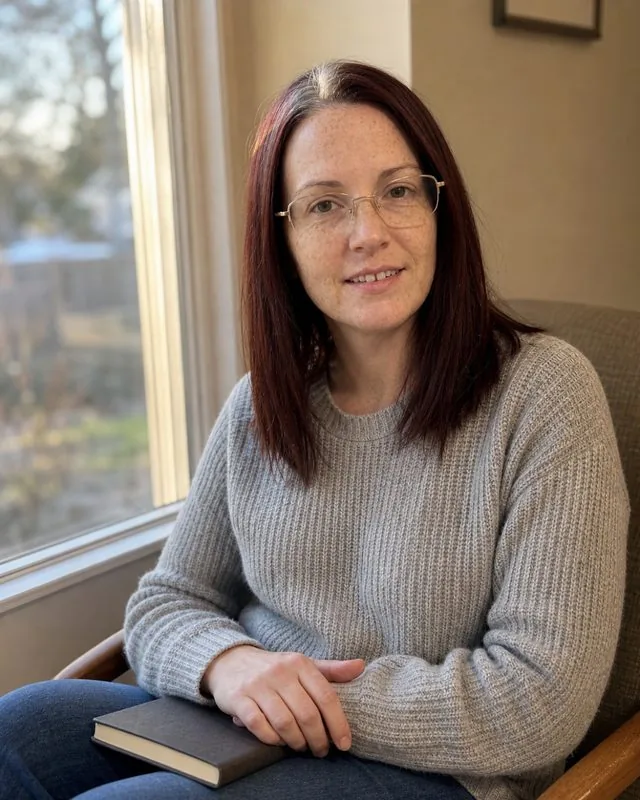
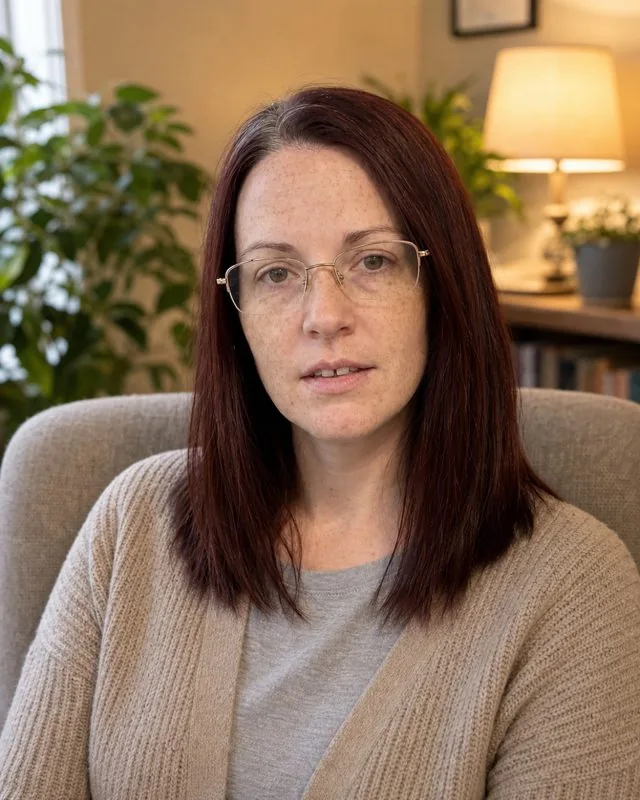
Which is why the shoot here is briefed as a person in a soft chair by a lamp, and not as a professional at a desk. Warm light, an unforced expression, nothing in the frame doing the work the face should be doing.
The shoot, in three rooms
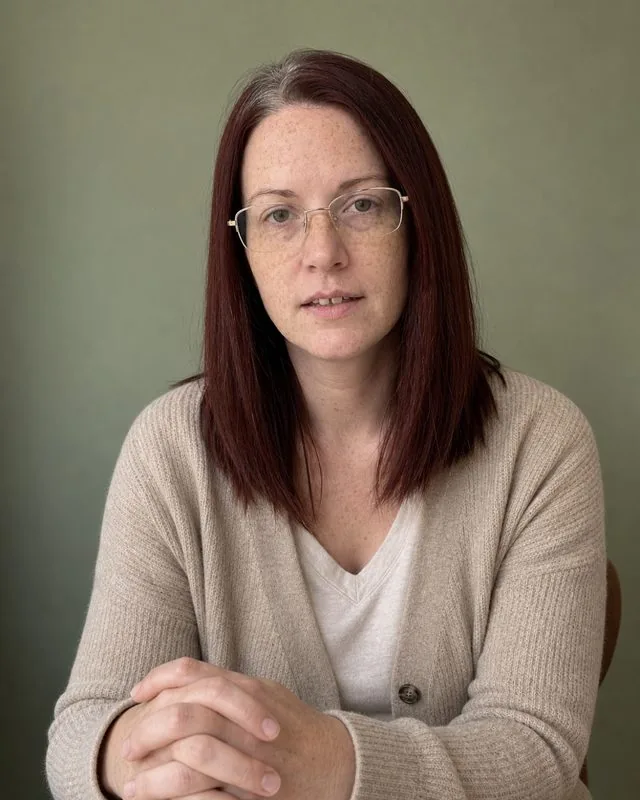
One person, three rooms, the same freckles and the same glasses in all of them. The middle frame is the one to crop for a list, because it is the one where the head fills the most of a tall rectangle.
What the codes actually regulate
Asked because therapists ask it, and answered by reading the codes rather than by guessing at them. None of the four names AI-generated portraits. What they do say is more useful than a ban would have been.
- APA 5.01eight topics, and appearance is not one
The code names directory listings, in those words, as a public statement subject to the rule against false or deceptive statements. Then it enumerates what the rule attaches to: training, degrees, credentials, affiliations, services, the clinical basis or results of services, fees, publications. A photograph of your face is not on that list.
- APA 5.02responsibility does not transfer
Psychologists who engage others to create public statements promoting their practice keep professional responsibility for them. Whether the image came from a photographer or from a tool, the person answering for it is you, which is an argument for using something that will not quietly change your face.
- NASW 4.04the broadest clause of the four
Social workers should not participate in, condone or be associated with dishonesty, fraud or deception, with no qualifier limiting it to credentials. Since the LCSW is the most common therapist licence in the United States, this is the wording that reaches furthest for the largest part of this audience.
- BACP 2026mandatory from 3 November 2026
The first professional framework in this field to mention AI at all. It asks members to be honest and transparent about their use of AI tools. On a plain reading it is aimed at tools used in the work and at client data rather than at a photograph of yourself, but it is broadly worded, no interpretation of it exists yet, and it is not in force at the time of writing.
Read together they point one way. The rule is not about how the picture was made, it is about whether the person in it is you, and the responsibility for that answer stays with you whoever held the camera. That is also the whole design of this engine: it will change the light, the wall and the cardigan, and it is built to refuse to change your face. This is not legal advice and we are not your ethics board. The texts are public and worth ten minutes of your own reading.
The first act of self-disclosure
The room comes within days
A therapy client meets you almost immediately after choosing you, which is a shorter gap than any other profession on this site. A photograph that flatters past recognition does not get away with it for a year; it gets found out in the first five seconds of the first session, in a relationship whose entire method is about what is safe to disclose.
Everything in the frame is material
A ring, a symbol, a body, a home interior behind you. In this profession those are not styling choices, they are disclosures, and a client will read them as such before you have decided whether you meant to make them. Choosing a plain wall is a clinical decision as much as a visual one.
What we will not do
No slimming, no smoothing, no years taken off, no straightened teeth. On most pages that is a positioning statement. Here it is the only version of this product that is compatible with the work, because the person who walks into your room has already met the photograph.
Asked by therapists
What size does the photo need to be for Psychology Today?
The advice you will read everywhere is 400 by 400 cropped to a circle, and it is wrong on both counts. The directory generates three renditions from whatever you upload, at 80 by 100, 120 by 150 and 320 by 400. All three are 4:5 portrait. The square and circular sizes those articles name are not served at all. Compose for a tall rectangle, and upload the largest file you have, because every rendition is derived from your original.
Is an AI headshot against the ethics code?
No code at APA, ACA, BACP or NASW names AI-generated portraits, and the APA guidance people cite about AI is confined to clinical use and says of itself that it is not policy and not enforceable. What does apply is more interesting than a ban: the code makes you responsible for public statements created on your behalf, and it regulates deception about credentials rather than about appearance. The honest reading is that the photograph sits under the general integrity principle, and that whether it deceives depends on whether the person in it is you.
Do I have to disclose that the photo was generated?
Nothing found requires it. The nearest thing to a rule is the BACP framework that becomes mandatory in November 2026, which asks for honesty and transparency about the use of AI tools; on a plain reading it is about tools used in the work and about client data, not about a marketing photograph, but the wording is broad and there is no guidance on it yet. A cautious practitioner may decide to say so. Nobody can currently tell you that you must.
Should the photo be taken in my office?
The evidence points away from it. In a controlled comparison of four therapist presentations, the one dressed and staged as a recognisable therapist, formal clothes and the props of the profession, rated lowest of the four both on being understood and on willingness to seek treatment. An older study of attire and seating found the strongest impressions came from casual dress with no desk, and that a desk between the two people lowered ratings from women on every measure. The room is not what a person is scanning the photograph for.
How much does the photo really matter?
More than is comfortable. In an experiment built to replicate a therapist directory, profiles with unattractive photographs performed no better than profiles with no photograph at all, and the effect held after controlling for perceived trustworthiness and competence. We are not going to pretend that is good news, and we are not going to answer it by making you look like somebody else. What a shoot here changes is light, background and clothing. Your face is the part it is built to leave alone.
Look at it at eighty pixels first.
8 photos free. Run the shoot, shrink the result to the size a stranger actually meets it at, and see whether it still looks like somebody you could talk to.
Get 8 free photos