Coat or scrubs is not a styling question.
It is set by your specialty, your unit's policy on sleeves, and which patients you see. All three have been measured.
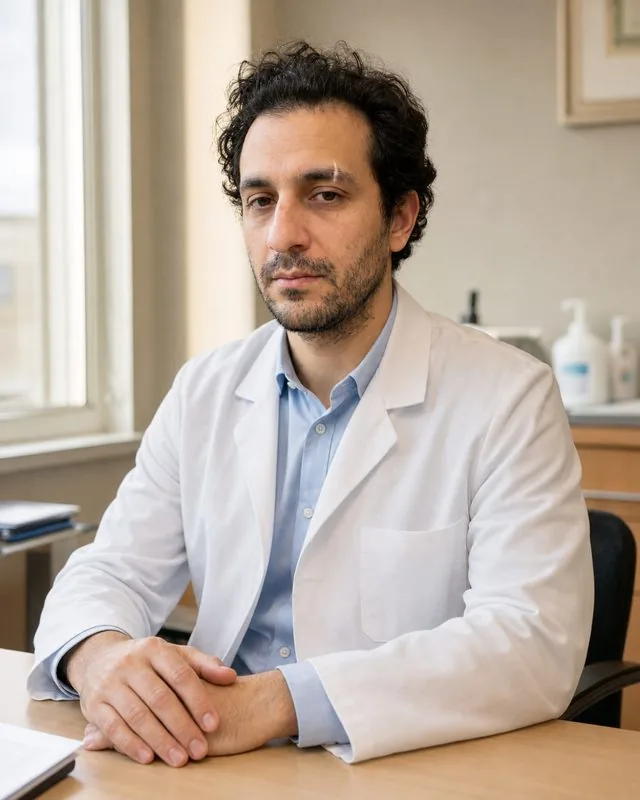
The coat, answered per setting
Almost every headshot guide answers this once, and the answer is wrong somewhere. Sourced in August 2026, from the patient studies and the workwear guidance rather than from photographers.
- Emergency and theatrescrubs, consistently
A 2025 systematic review of 28 studies found scrubs favoured in high-acuity settings without much disagreement between the studies. This is the clearest single answer in the whole literature.
- Clinic, patients over 65formal attire and a coat
The largest study of the question, 4,062 patients across ten academic hospitals, found formal attire with a white coat rated highest of seven options, that 53 per cent said physician attire mattered to them during care, and that over a third said it influenced their satisfaction with the care itself.
- Dermatology, neurosurgery, ophthalmologythe coat
The same review found a clear preference for the white coat in these specialties, and mixed evidence in outpatient and primary care. There is no single answer that survives being moved between them.
- A UK hospitalno long sleeves at all
After the 2007 Department of Health workwear evidence base, most NHS trusts adopted bare below the elbows: short sleeves, no wristwatch, no hand jewellery, no tie during clinical activity. The traditional long-sleeved white coat effectively left British hospitals two decades ago, so a British doctor photographed in one is dressed in something their own hospital stopped using.
- Any coat at alla laundry interval
A December 2025 study swabbed the sleeves of staff in long-sleeved attire during direct inpatient care: of 280 samples, 81 per cent grew bacteria and 21 per cent grew at least one potential pathogen. The coat in your photograph is a garment with a service schedule, which is why an off-the-peg pristine one can look subtly wrong in a working corridor.
And one finding that is not about clothes at all. The same 2025 review reported that male physicians were perceived as more professional in formal attire with a white coat, while women in the same attire were often misidentified as nurses or assistants, across different cultural settings. That is the reason the credential line beside a woman's photograph is doing work, and why its placement is not a design detail.
What this shoot is, and what it is not
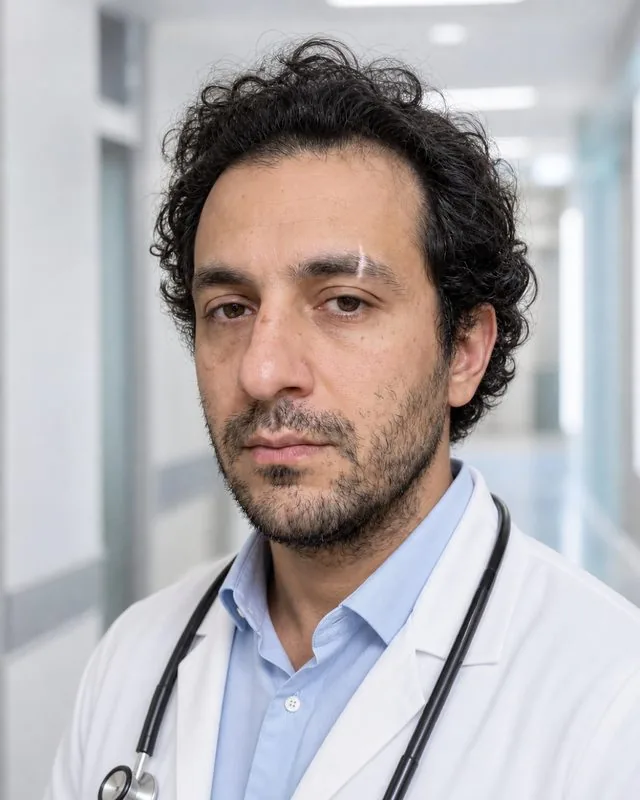
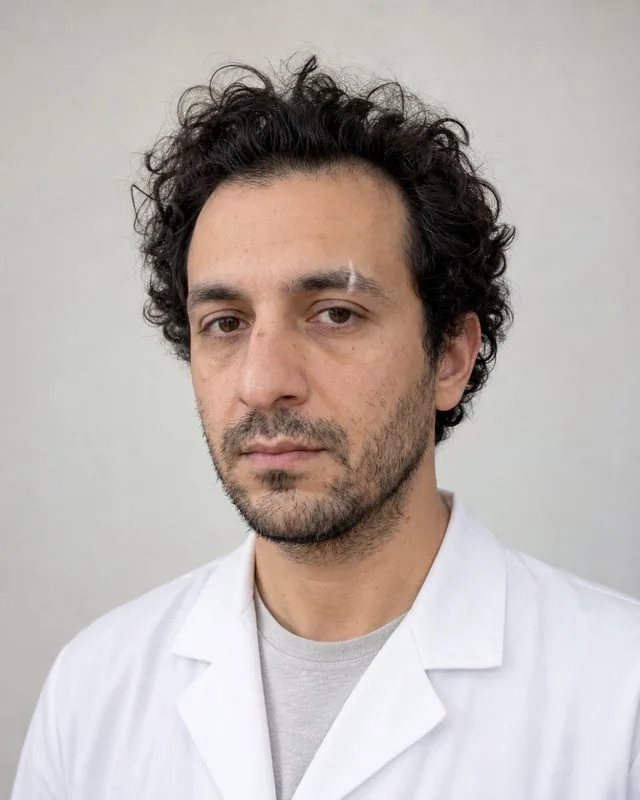
All three setups are briefed in a white coat, so if the answer above was scrubs, this shoot is not the one for you and there is not currently another. Saying that costs a sale and saves an afternoon. The third frame is the one to keep for a directory: a pale wall, nothing behind the head, and no corridor for a patient to walk into.
One thing you will not find in these frames is a badge with anything written on it. In California a practitioner's badge is a statutory object carrying a name and licence status in at least eighteen point type, and an invented one is the single element in a clinical portrait a patient might actually try to read.
Check your employer before you check the law
This is the one profession on this site where a named institution has already written the rule down, and it says no. Yale School of Medicine's photo requirements state that AI-generated or AI-assisted headshots must follow the school's brand guidelines. Those guidelines say AI visuals must not be confusable with real people, that AI depictions of people should be limited to anonymous elements such as a hand on a keyboard or a silhouette, and that AI content must be noted in a watermark, a caption or the image metadata.
Read together, a generated face does not belong on that faculty page. Other institutions may have said nothing at all. The point is that the question has an answer and it is not ours to give: it belongs to whoever runs your profile page.
The profession's own body has moved too. The American Medical Association published a framework in April 2026 holding that a physician's name, image, likeness, voice and digital replicas are protected, and that AI-generated or altered depictions of physicians should be clearly labelled in plain language. It is advocacy rather than law, and it is aimed squarely at impersonation and fake endorsements rather than at a doctor making their own portrait. It is still the standard your colleagues will judge by.
Which is a strange thing for us to put on a page selling generated photographs, and it is here for the same reason everything else on this site is: you would find it out later, and later is after you paid.
Where it goes
Three destinations that want three incompatible files, and the third is not the same photograph at all.
- An academic faculty profile960 x 1200 px at 300 dpi, 1 to 10 MB
Yale School of Medicine publishes that floor, wants head and shoulders not cropped too closely to the head, and explicitly rejects selfies, candids, phone photographs, anything blurry, and photos with excessive retouching or filters applied. Note the file size is a range with a floor, not a cap.
- A booking directory3:4 portrait, provider only
Healthgrades asks for portrait format cropped for 3 by 4, 768 by 1024 or larger, up to 10 MB, and a photograph of the provider alone: no colleagues, no practice or facility shots. Portrait 3:4 is the opposite of the square crop a professional network wants from the same face.
- A licensure applicationpassport format, weeks old
Several state boards want a recent passport-quality photograph with an explicit recency window: Oregon within 90 days of filing, Indiana within the last eight weeks. Maryland refuses full-body photographs, photographs with other people in them, photocopies and scans. This is not your marketing headshot and it never will be.
What a shoot here hands you is 1152 by 1440, which clears the academic floor on the short edge and the booking directory on both. The file size is worth watching in the other direction: an academic profile that wants at least a megabyte will refuse a tidy export, in exactly the way most upload forms do not.
Twenty-one profiles, then a decision
The photograph is a thumbnail in a stack
A 2026 report on how patients choose found they reviewed an average of twenty-one provider profiles before booking, thirty-one for a psychologist, and ranked a positive personal connection above ratings and above proximity. The picture is doing selection work at a size where credentials are unreadable.
Polish is not always the signal
A 2025 study of patients in telemedicine treatment found nearly sixty per cent preferred a real background to a virtual one, and that the majority had no preference about attire, with those who did preferring casual. For telehealth-heavy practice, the studio-grey coat portrait can be the wrong answer confidently delivered.
And the face has to survive the room
Whatever the photograph promised, a patient sees you in a consulting room shortly afterwards. No slimming, no smoothing, no years removed: the engine changes the light, the wall and the coat, and it is built to leave your face where it found it.
Asked by clinicians
Should I wear the white coat?
It depends on where you work, and the evidence is specific rather than vague. Scrubs are consistently favoured in emergency and operating settings. Formal attire with a white coat rated highest in the largest patient study, which was conducted in academic clinics and where the effect was strongest among patients over 65. The white coat is preferred in dermatology, neurosurgery and ophthalmology, and the evidence is mixed in outpatient and primary care. In the UK the question mostly does not arise, because bare below the elbows removed the long-sleeved coat from hospitals nearly two decades ago.
Does the length of the coat matter?
It is a credential. The short hip-length coat belongs to medical students and the full knee-length coat comes with graduation into residency, so that patients can identify who they are speaking to. A student photographed in a long coat is making a claim about their stage of training whether or not they meant to.
Can I use an AI headshot as a physician?
Check your employer before you check anything else, because at least one named institution has already answered no. Yale School of Medicine requires that AI-generated or AI-assisted headshots follow its brand guidelines, and those guidelines say AI visuals must not be confusable with real people, that AI depictions of people should stay to anonymous elements, and that AI content must be noted in a watermark, caption or metadata. A synthesised face on that faculty page does not comply. The American Medical Association separately published a framework in April 2026 holding that AI-generated or altered depictions of physicians should be clearly labelled in plain language; that is policy and advocacy rather than law, but it is the standard the profession has written down.
Is my directory photo legally an advertisement?
In California it is. Business and Professions Code section 651 makes it unlawful for a licensed health practitioner to disseminate a public communication containing a false, fraudulent, misleading or deceptive statement, claim or image likely to induce someone to seek services, and its definition of a public communication names a list or directory of practitioners and the internet. It is the only profession on this site whose headshot sits inside a misdemeanour statute. The credential line under it is regulated too: a physician may not use the term board certified without naming the certifying board with comparable prominence.
Can I be photographed in the department?
Only with the paperwork. Under the HIPAA privacy rule, full face photographic images and comparable images are one of the eighteen identifiers that make information protected, so a patient in the background of a corridor shot is not a styling problem, it is a disclosure. Health systems that publish standards say a release should be obtained when photographing in clinical settings. This is the practical reason department portraits get made in empty corridors, on days off, or with colleagues standing in.
Ask your communications office first. Then try it.
The first 8 are free and nothing is charged before them. If your institution has written a rule about this, reading it costs less than a photograph you cannot use.
Get 8 free photos